

Article: Full-Grain vs. Vegan (Faux) Leather: Which Lasts Longer?
Full-Grain vs. Vegan (Faux) Leather: Which Lasts Longer?
Full-Grain Leather vs. Vegan (Faux) Leather: Which Actually Lasts Longer?
When comparing full-grain leather vs. vegan leather, appearance on day one tells only part of the story. Daily pocket friction, repeated folding, moisture, and care all affect how a wallet or accessory wears over time.
Well-made full-grain leather can be a durable choice for long-term use, while vegan leather offers an animal-free alternative. Neither label alone guarantees a particular lifespan: material quality, construction, finish, and how you use the item all matter.
What Makes Full-Grain Leather So Resilient?
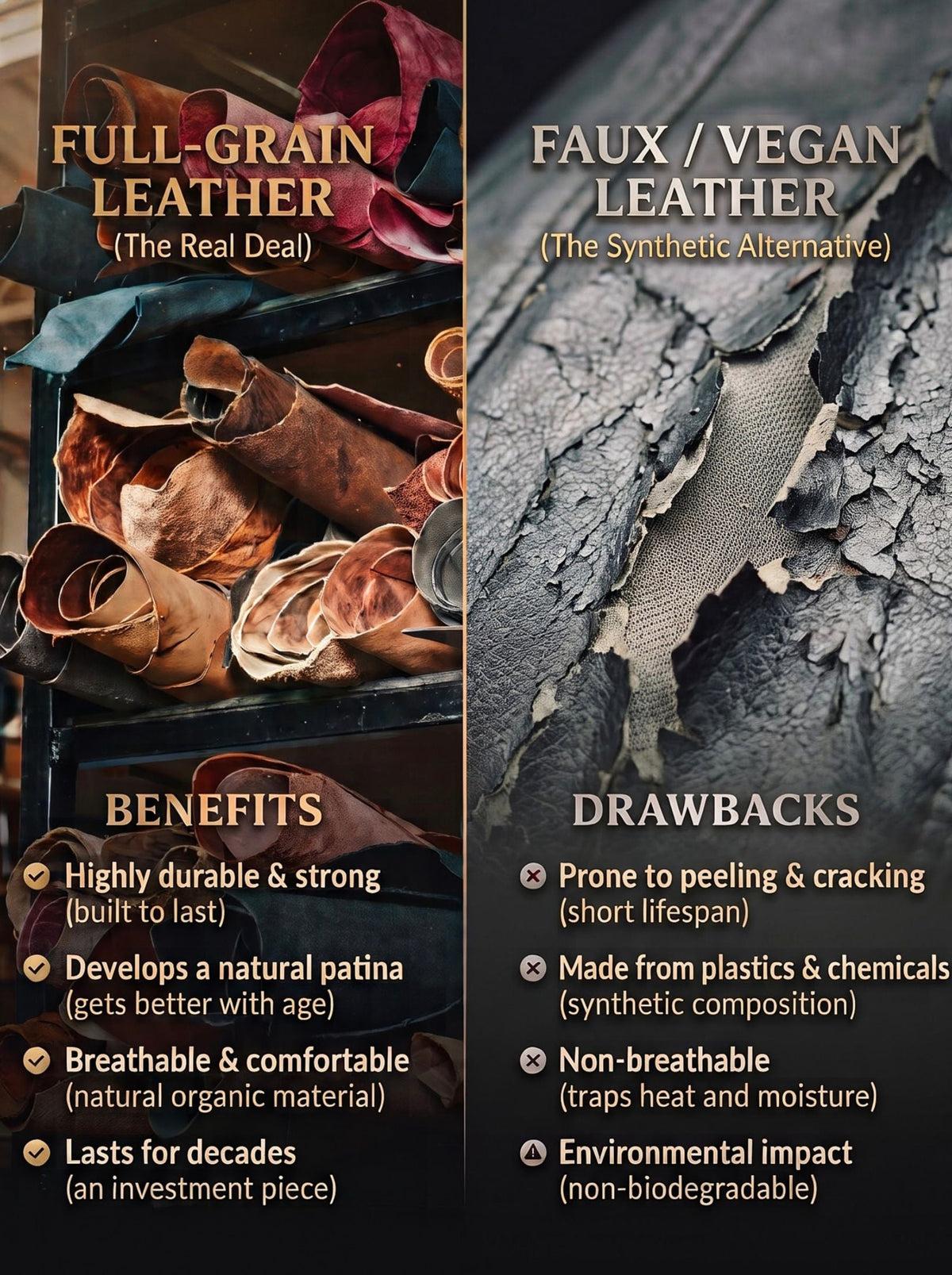
Full-grain leather retains the hide's natural grain surface rather than having it sanded away. It is valued for its natural character and potential durability, although the quality of the hide, tanning, and construction still influence the finished product.
Here are three characteristics to consider:
- Strength: The retained grain structure can contribute to strength, but thickness, hide quality, and construction also matter.
- Breathability: Leather's ability to handle moisture varies with its tanning and surface finish. It should not be treated as waterproof.
- Patina development: Use and exposure can change the surface's color and sheen. Some people value this character, while others prefer a more uniform appearance.
Aniline leather is colored with soluble dyes rather than an opaque pigment coating, allowing natural grain variations to remain visible. Its appearance can change with use, and it can be susceptible to marks, stains, drying, and other damage. Aniline leather is not a guarantee against surface deterioration.
What Is Vegan (Faux) Leather Actually Made Of?
"Vegan leather" describes animal-free alternatives rather than one standardized material. Check the specific composition before drawing conclusions about durability:
- Polyurethane (PU) and PVC: Faux leather can be made with a fabric backing and a polymer coating that creates a leather-like surface. Performance varies by formulation, coating, and backing.
- Plant-based alternatives: Materials incorporating cactus, apple, pineapple, or other plant-derived ingredients vary in composition. Some include synthetic binders or coatings, so a plant-based label does not establish that a product is plastic-free or biodegradable.
Some coated alternatives can crack, peel, or separate from their backing as they age. Certain polyurethane formulations are vulnerable to hydrolysis, a moisture-related degradation process. How quickly deterioration occurs depends on the material and conditions; it is not the same for every vegan leather product.
Real Leather vs. Faux Leather Durability: Side-by-Side Comparison
| Feature | Full-Grain Leather | Vegan (Faux) Leather |
|---|---|---|
| Lifespan | Can provide long service with suitable construction and care; no fixed lifespan | Varies widely by material, construction, use, and storage; no fixed lifespan |
| How It Ages | May soften and develop patina; can also stain, dry, or crack | May retain a uniform finish, scuff, crack, or peel, depending on composition |
| Tear & Abrasion Resistance | Depends on hide quality, thickness, finish, and construction | Depends on coating, backing, thickness, and construction |
| Reaction to Moisture & Oils | Can absorb moisture and oils; follow material-specific care guidance | Water and oil resistance vary; follow the manufacturer's guidance |
| Repairability | Some stitching and surface damage can be repaired; not all damage is reversible | Some repairs are possible, but a peeling coating can be difficult to restore durably |
| Cost Per Year | Depends on purchase price, maintenance, repairs, and actual years of use | Depends on purchase price, maintenance, repairs, and actual years of use |
How Everyday Carry Tests Material Limits
Material labels are a starting point. Consider how an item will handle repeated bending, friction, and the conditions of your daily routine.
Wallets and Constant Pocket Friction
A daily wallet experiences repeated folding, body heat, moisture, and contact with clothing or other pocket contents. Overfilling it can place extra strain on the folds, pockets, and seams.
When choosing a full-grain or vegan leather wallet, look for secure stitching, neatly finished edges, and a layout that fits what you carry without stretching. Full-grain leather may soften and mold with use; coated alternatives can show wear at folds and edges. Neither outcome follows a universal timetable.
Tech Sleeves and Structural Protection
Laptop cases face repeated handling, contact with bag zippers, and wear around corners. Material durability is only one part of their protective design.
For a MacBook cover or sleeve, assess fit, lining, padding, closures, and reinforced edges as well as the outer material. Leather alone does not establish drop protection, and a synthetic sleeve is not necessarily less protective. Look for product-specific testing if impact protection is a priority.
The Sustainability Angle: Longevity vs. Disposable Cycles
Keeping an item in use longer can reduce how often you need to replace it, but durability alone does not establish which material has the lower overall environmental impact.
Raw materials, farming or feedstocks, tanning or chemical processing, manufacturing, care, and end-of-life treatment all matter. Neither "natural," "vegan," nor "plant-based" is enough to prove an environmental advantage. Look for transparent composition information and credible evidence supporting specific environmental claims.
How to Spot True Full-Grain Leather Before You Buy
"Genuine leather" does not, by itself, identify a specific leather grade. To understand what you are buying, ask the seller about the hide, grain, tanning, finish, and construction:
- Inspect the surface grain: Natural variations can offer clues, but appearance alone is not proof of full-grain leather. Embossing and finishes can change the surface of real leather too.
- Check the edges and underside: Visible construction can help you understand the material, but linings and folded edges may hide it. Ask for clear material specifications if you are unsure.
- Do not rely on scent or touch alone: Treatments and finishes affect both. A smell or feel test cannot reliably establish grade, tanning method, or authenticity.
- Look at the stitching: Check for even stitches, secure seams, and clean edge finishing. Good construction matters for both leather and animal-free alternatives.
Choosing Materials Built for the Long Haul
If avoiding animal-derived materials is your priority, compare vegan options by their actual composition, construction, care instructions, and warranty rather than assuming they all perform alike.
If you value natural grain and an appearance that develops with use, a well-made full-grain leather item can be a strong choice. Choose a design that suits your routine, avoid overloading it, and follow its specific care instructions. Use only suitable care products, testing them on a discreet area first. Thoughtful buying and care are more useful than a promised lifespan.
Explore Our Handmade Leather Wallets
Turquoise Slim Bifold Wallet

Shop the Turquoise Slim Bifold Wallet
Black & Red Two-Tone Bifold Wallet


Leave a comment
This site is protected by hCaptcha and the hCaptcha Privacy Policy and Terms of Service apply.